South Florida only; expanding slowly
Large males; average adults ~3.5 m
Long-lived, slow-reproducing species
Total global range pop approx 500,000-1 million
America's Only Native Crocodile
The American crocodile (Crocodylus acutus) is the only member of the family Crocodylidae native to the continental United States. Its US range is restricted to the southernmost tip of Florida: the Everglades National Park, Florida Bay, Biscayne Bay, and the Florida Keys. This makes it the northern extreme of a range that extends south through the Caribbean islands, Central America, and the Pacific and Caribbean coasts of South America as far south as Peru and Venezuela.
In the United States, the American crocodile and the American alligator overlap only in this narrow southern zone, making south Florida the only place on Earth where wild alligators and crocodiles coexist. They partition habitat: alligators dominate the freshwater interior marshes, while crocodiles favour the brackish and saltwater coastal areas.
The US population was listed as Endangered under the Endangered Species Act in 1975, when as few as 200 to 400 individuals remained in Florida. Recovery efforts, including habitat protection and nest monitoring by Florida FWC, have brought the number to approximately 2,000 adults in the state. In 2007, the US status was downlisted from Endangered to Threatened, reflecting this recovery.
Appearance and Identification
The American crocodile is noticeably lighter in colour than the American alligator. Adults are typically pale grey, olive-grey, or tan with darker banding or flecking, especially in younger individuals. The underside is cream or white. The lighter colouration is one of several visual differences from the alligator.
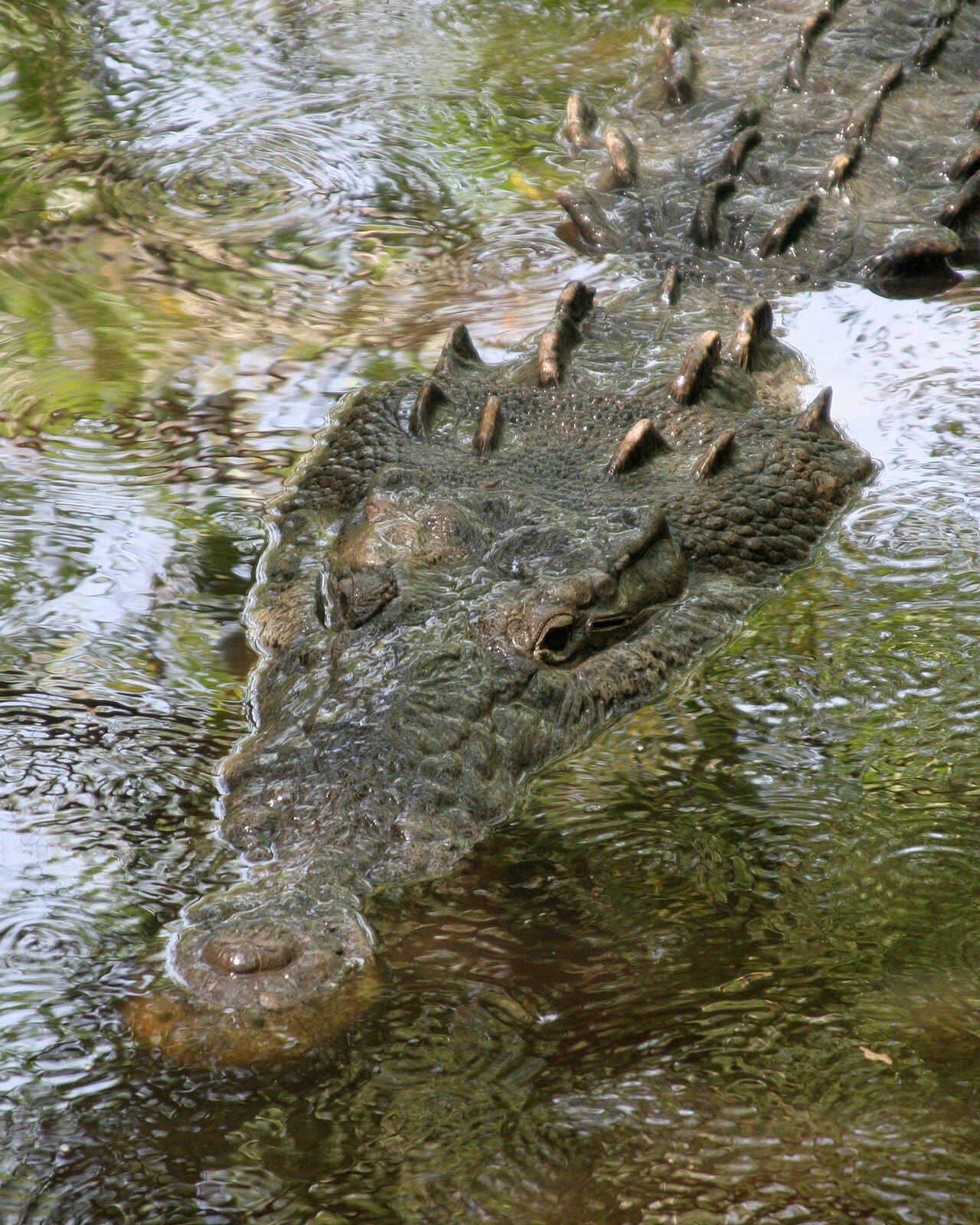
Like all crocodiles, the American crocodile has a long, tapering V-shaped snout, in contrast to the broad U-shaped snout of alligators. When the mouth is closed, the enlarged fourth lower tooth on each side of the jaw remains visible outside the upper jaw -- the diagnostic "exposed tooth" character of true crocodiles.
American crocodiles have functional lingual salt glands on the tongue that allow them to tolerate and actively excrete salt. This physiology underlies their preference for coastal, estuarine, and brackish habitats, and enables the dispersal journeys of up to several hundred kilometres through saltwater documented for individuals in the Caribbean.
Geographic Range
The American crocodile has the widest geographic range of any crocodile species in the Americas. It occurs on both the Atlantic and Pacific coasts and is the only crocodilian in many Caribbean island groups. Populations have been recorded in:
- --South Florida (Everglades, Florida Bay, Biscayne Bay, Florida Keys)
- --Cuba, Jamaica, Hispaniola, and several smaller Caribbean islands
- --Both coasts of Mexico and all Central American countries
- --Colombia, Venezuela, Ecuador, Peru (Pacific coast populations)
While globally the species has a substantial total population estimated at 500,000 to 1,000,000 individuals, many subpopulations are small and fragmented. The species is IUCN Vulnerable because of habitat loss, hunting, and the vulnerability of small populations to local extirpation. The Florida population, though recovering, represents the global range edge and is particularly vulnerable to hurricanes and sea level rise.
Diet, Behaviour, and Danger
American crocodiles are primarily fish-eaters in Florida, supplemented by crustaceans, turtles, birds, and small mammals. Larger individuals will take larger prey including deer and domestic animals. They are ambush hunters, lying in wait at the water surface.
Unlike Nile and saltwater crocodiles, American crocodiles in the United States are generally regarded as shy and non-aggressive toward humans. Documented human attacks by American crocodiles are extremely rare. Florida FWC has recorded very few confirmed attacks by this species in Florida's history.
This relative timidity is believed to reflect a population that has coexisted with low-density human use of its habitat. In parts of Central America where crocodiles are hunted or harassed, behaviour and encounter frequency differ. Visitors to the Tarcoles River bridge in Costa Rica observe American crocodiles daily from a safe vantage point -- one of the most accessible wild crocodile viewing spots in the world.