Mainly Chambal River, India; critically endangered
Males large; among longest crocodilians
No confirmed fatal attacks on humans ever recorded
Down from ~10,000 in 1940s
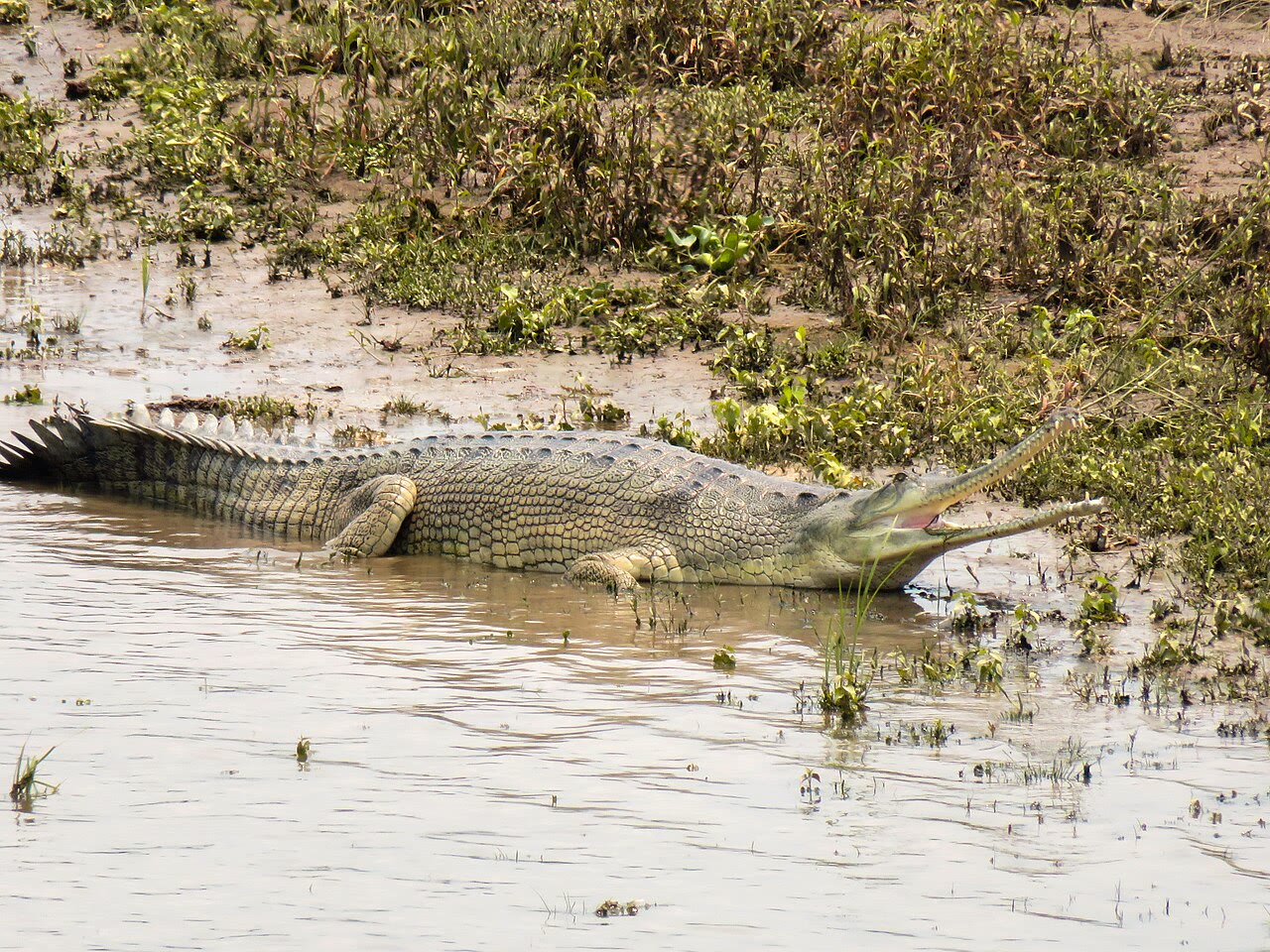
Unlike Any Other Crocodilian
The gharial is instantly recognisable. Its snout is extremely long, narrow, and cylindrical -- proportionally the longest of any crocodilian -- and lined with approximately 110 interlocking, needle-sharp teeth ideal for seizing slippery fish. The overall snout-to-body ratio is unlike any other species in the order Crocodylia. In adult males, the tip of the snout bears a large bulbous nasal excrescence called a "ghara" (Hindi for "earthen pot"), which is the origin of the common name. The ghara is absent in females and juveniles.
Taxonomically, gharials occupy their own family, Gavialidae, separate from both Crocodylidae and Alligatoridae. The false gharial (Tomistoma schlegelii) of Southeast Asia was once placed with the gharial, but genetic analysis now places it within the true crocodile family.
Gharials cannot perform the "high walk" used by most crocodilians on land -- they lack the limb structure for it. On land they can only 'belly slide,' pushing with their legs while the body drags on the substrate. This terrestrial helplessness means gharials almost never leave the water except to nest and bask.
Habitat: Fast-Flowing Rivers
Unlike most crocodilians, which can tolerate a wide range of water bodies, gharials are highly specialised for deep, fast-flowing rivers with sandy banks for nesting. Their limb structure, so poorly adapted for walking, is well-suited to powerful tail-driven swimming in river currents. Historically they occupied the Indus, Ganges, Brahmaputra, Mahanadi, and Irrawaddy river systems.
Today the population is concentrated in the National Chambal Sanctuary in Madhya Pradesh and Rajasthan (India), with small groups in the Girwa River in Uttar Pradesh's Katerniaghat Wildlife Sanctuary, and a critically small population in Nepal's Narayani River. Occasional individuals have been reported in the Mahanadi and Son rivers, but these are thought to be dispersing individuals rather than established breeding populations.
Conservation Crisis
In the 1940s, an estimated 10,000 or more gharials lived across the Indian subcontinent. By 1975, hunting for hides and eggs, combined with sand mining from nesting beaches and irrigation dams fragmenting river systems, had reduced the population to around 200. The species was listed as Endangered. India launched a captive breeding and restocking programme in the late 1970s, releasing thousands of captive-reared juveniles into protected river sections.
The programme partially succeeded: the population recovered to an estimated 1,500 to 2,500 by the mid-2000s. But in late 2007 and 2008, a mysterious mass mortality event killed over 100 gharials in the Chambal River. Investigation pointed to gout-like kidney disease potentially triggered by chemical contamination. The population has not recovered to mid-2000s levels. Current estimates from the Gharial Ecology Project and Indian government surveys place the total mature breeding population at approximately 650 individuals.
Primary current threats include continued sand mining from nesting beaches (which is illegal but widespread), entanglement in fishing nets, depletion of fish stocks, and river pollution. The gharial's extreme habitat specialisation means it cannot adapt to degraded rivers the way generalist species can. Without sustained protection of its specific nesting and hunting rivers, extinction within decades is a realistic outcome.
Not a Danger to Humans
Despite growing up to 6 metres, gharials have never been documented killing a human. Their long, fragile, fish-adapted jaws could not deliver the bite force or grip needed to subdue a large mammal. Their teeth are designed for fish, not for the death-roll predation of Nile or saltwater crocodiles.
Large males have been known to charge at intruders near nesting sites, but this appears to be threat display rather than predatory attack. Gharials should be treated with respect as wild animals, but they pose no meaningful danger to people.