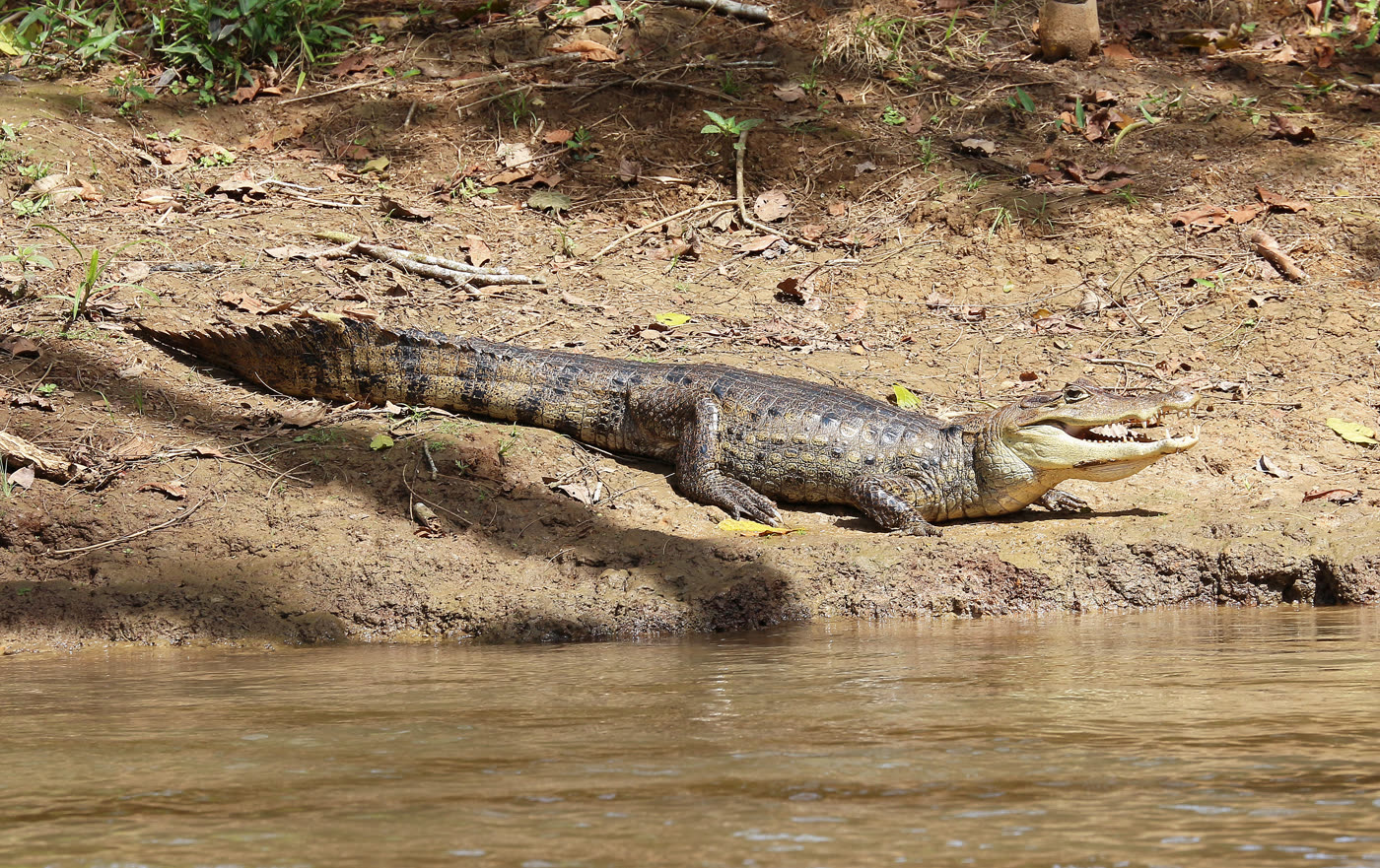
Caiman vs Crocodile: Key Differences
Caimans belong to the family Alligatoridae, the same family as alligators. This makes them closer relatives of alligators than of crocodiles. Like alligators, caimans have a wide jaw with only upper teeth visible when the mouth is closed, and they lack functional lingual salt glands (hence their restriction to freshwater and tropical America). Unlike the American alligator, caimans have heavily ossified bony armour on the ventral (belly) side as well as the dorsal, making caiman leather harder to tan and less commercially valuable.
True crocodiles (family Crocodylidae) have functional salt glands, a more V-shaped snout, and both upper and lower teeth visible when the mouth is closed. Geographically, any crocodilian in the Americas south of Florida is a caiman or an American crocodile -- never an alligator.
The Six Living Caiman Species
World's most numerous crocodilian. Highly adaptable. Has colonised parts of Florida as introduced species.
The widest snout of any caiman. Southern Brazil, Uruguay, Paraguay, Argentina. Specialises in hard-shelled prey like snails and crustaceans.
The dominant crocodilian of the Pantanal wetland. Millions live in the Pantanal -- one of the highest crocodilian densities on Earth.
Largest caiman. Previously heavily hunted; now recovering. Apex predator of Amazonian freshwater. Dangerous to humans in remote areas.
World's smallest crocodilian. Named after Baron Cuvier. Heavily armoured ossified osteoderms. Inhabits cold, fast-flowing streams -- unusual for crocodilians.
Highly terrestrial for a crocodilian. Found far from large water bodies. Heavily ossified skin.
The Invasive Spectacled Caiman in Florida
The spectacled caiman (Caiman crocodilus) has established a small but breeding invasive population in Dade County, Florida, primarily in the Miami canal systems. Individuals were released or escaped from the pet trade. Spectacled caimans are legally sold as pets in most US states, and small animals are sometimes released or escape.
The Florida population is estimated at a few hundred to perhaps 1,000 individuals. They are significantly smaller than American alligators and American crocodiles and are not considered a public safety risk at their current population density. Florida FWC monitors the population but has not pursued active eradication.
Identification in Florida is straightforward: if the animal is very small (under 1 metre) and has a distinctive bony ridge between the eyes that looks like the nose pad of spectacles, it is most likely a spectacled caiman, not a juvenile alligator. Juvenile alligators lack this interorbital ridge.