Most adults 3.5-5 m; 6+ m are rare giants
Erickson et al. 2012; strongest ever measured
Exact data scarce; attacks heavily underreported
Northern Australia has largest concentration
The World's Largest Living Reptile
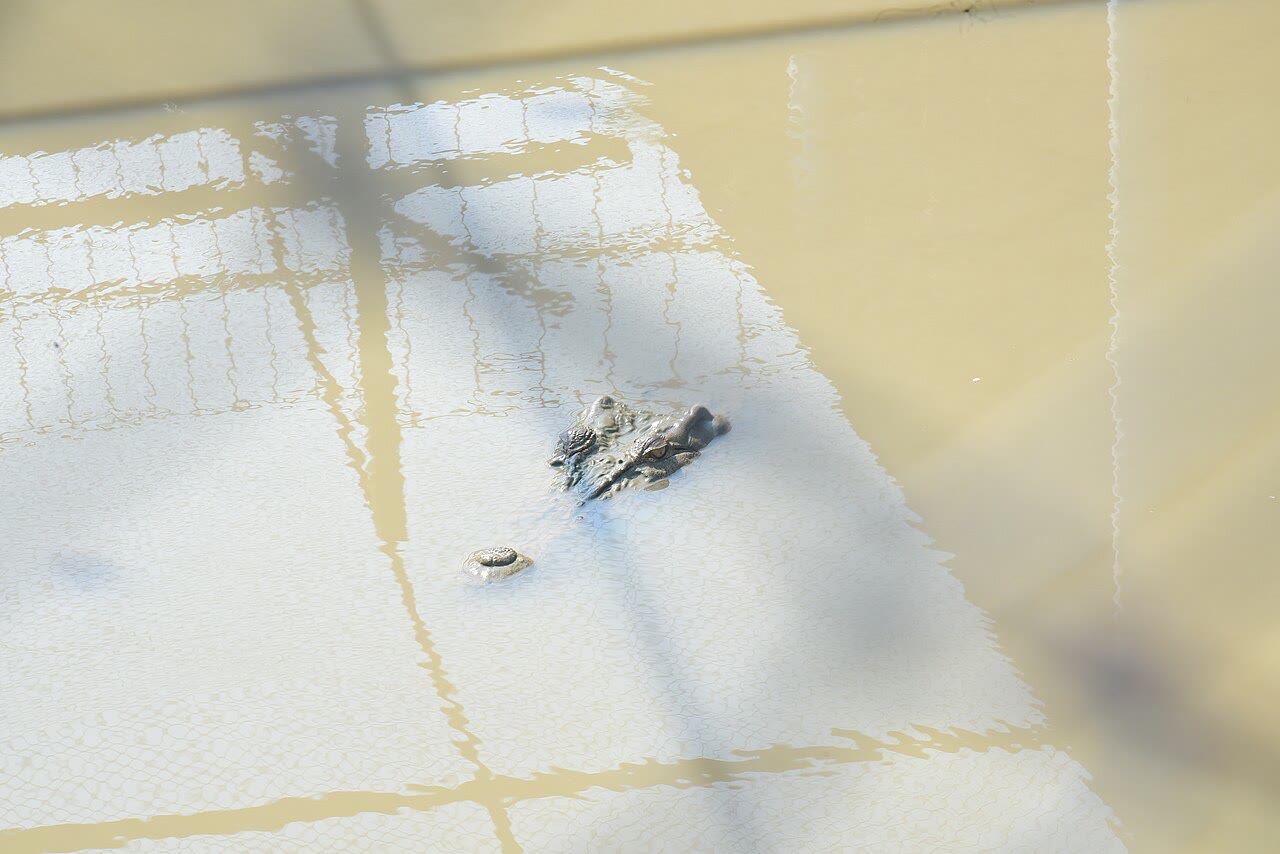
Crocodylus porosus -- the saltwater crocodile, also called "saltie" in Australia -- holds the record as the world's largest living reptile by mass. The largest reliably measured wild specimen in modern times, shot in the Philippines in 1823, was approximately 6.3 metres (20.7 feet) and estimated to weigh over 1,000 kilograms. Contemporary large individuals in northern Australia regularly reach 5 to 6 metres.
The species has a geologic history extending back to the Cretaceous, making it one of the most successful animal lineages in evolutionary history. It has survived three mass extinction events. Its combination of armoured skin, powerful jaws, stealth hunting, and physiological flexibility in salt tolerance make it one of the most formidable apex predators alive.
Despite its common name, the saltwater crocodile is not exclusively marine. It uses a wide variety of habitats: tidal rivers, estuaries, coastal lagoons, freshwater swamps, and mangrove forests. Adults can and do swim long distances in open ocean -- verified crossings of 400 to 600 kilometres between island groups have been recorded using GPS tracking. This ocean-crossing ability explains how the species colonised so many IndoPacific islands.
Range: From India to Australia
The saltwater crocodile has the broadest range of any crocodile species, spanning roughly 10,000 kilometres from eastern India in the west to Fiji in the east, and south to northern Australia. Key populations exist in:
Largest single population. Darwin Harbour and Kakadu National Park are the most accessible wild viewing sites. Protected since 1971; population rebounded from near-extinction.
Large population across coastal lowlands. Important traditional cultural significance. Commercial harvest regulated.
Populations fragmented. Habitat loss and hunting pressure significant. Some remote river systems still hold large individuals.
Small coastal populations. Sundarbans mangrove delta shared with Bengal tigers and humans -- attacks documented.
Bite Force: The Scientific Record
The definitive bite force measurements for crocodilians come from Gregory Erickson et al., published in PLOS ONE in 2012 ("Insights into the Ecology and Evolutionary Success of Crocodilians Revealed through Bite-Force and Tooth-Pressure Experimentation"). Erickson's team used a custom bite transducer to measure all 23 living crocodilian species.
A large saltwater crocodile produced a bite force of 16,460 newtons (3,700 lbf). This is the highest bite force ever recorded for any living animal, and substantially higher than the largest Nile crocodile measured (approximately 13,800 newtons / 3,100 lbf). For context, a hyena -- one of the strongest mammal biters -- produces approximately 890 lbf. A great white shark is estimated at around 4,000 lbf, though measurement methodology differs.
Danger note
Saltwater crocodiles are classified as responsible for more fatal attacks on humans than any other crocodile species in Australia. Northern Territory Health data shows an average of 1 to 3 fatal attacks per year in Australia, with more in PNG and Indonesia where reporting is incomplete. Unlike American alligators, saltwater crocodiles actively pursue and predatorily attack adult humans. Treat any encounter in their range as potentially life-threatening.